
A true crime podcast reached No. 3 among the most listened-to podcasts in Spotify’s history. Other titles in the genre also made the top 10 of its global ranking published in April 2026. That’s an impressive result. But when an episode ends, what makes someone look for the next one?
Around Halloween, it’s easy to bring horror podcasts and true crime podcasts into the same conversation. Suspense connects the two, but the difference matters: in a true crime podcast, the crimes actually happened. A broad search like “Spotify podcast” can lead to that first listen. Coming back for the next case depends on the connection with the person telling the story.
True crime podcasts: how the genre moved beyond its niche and into the charts
In 2024, 22% of weekly podcast listeners in the U.S. followed true crime, according to Edison Research. In the first half of 2026, it overtook comedy among the topics this audience listened to. These surveys have different scopes, but they help put the genre’s presence into perspective.
A ranking shows how far a show has reached. To understand why people stay, look at the work between episodes: the reporting, the way the story is told and the questions listeners send in that become part of the next story.
Why do true crime podcasts work so well in audio?
Someone finishes giving their account. There’s a pause. You’re still trying to piece that information together when the narration introduces something else. In audio, the order of the facts and the length of each silence help build suspense. An investigative podcast can reconstruct a case with room for context and questions, without rushing to the next revelation.
For 50% of American true crime listeners surveyed by Edison, suspense is a draw. That doesn’t mean making up clues to keep the tension going.
The storyteller becomes part of the story, too
Crime Junkie changes cases, but it has a signature style. Ashley Flowers’ narration gives the show a rhythm listeners recognize before they even know which story is coming. That recognition doesn’t depend on an exceptional case.
If you make a true crime podcast, it’s worth listening to your own show beyond the case you’ve chosen. Would your audience recognize your way of telling a different story?
When listening becomes participation
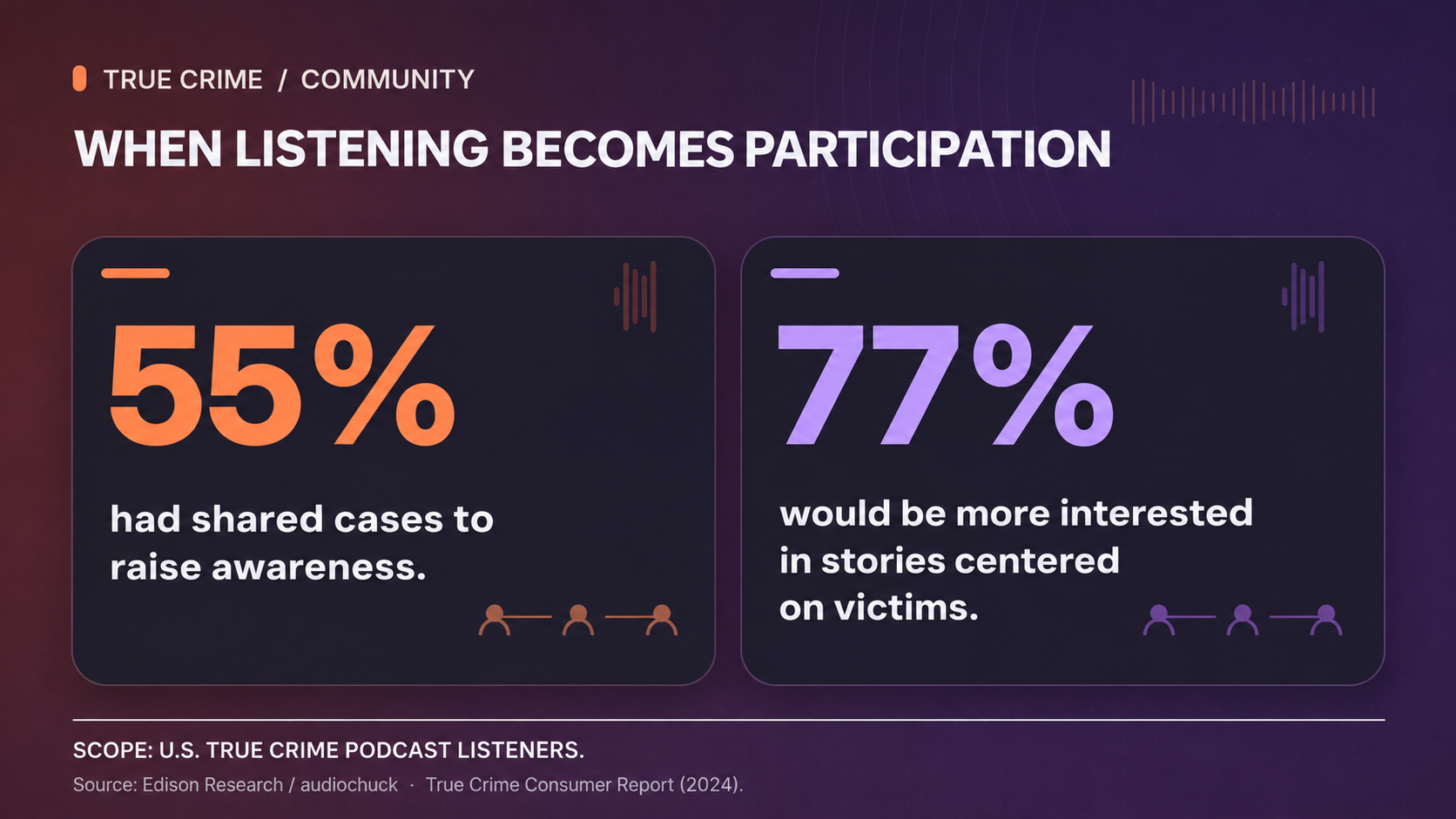
In Edison’s U.S. survey, 55% of true crime podcast listeners had shared cases to raise awareness of them; 25% had donated to causes or organizations. Here, listening can turn into action.
Fans of My Favorite Murder call themselves Murderinos and even have a club with bonus episodes and early access to shows. The conversation became a shared identity, as we explore in The Evolution of Fans in the Digital Age. But there’s a boundary: theories about real crimes must not turn into accusations.
The case is content, but the people involved aren’t characters
A 2025 study interviewed 20 people close to individuals involved in cases covered in true crime. They described errors, invasions of privacy and the pain of reliving stories exposed to the public. The episode ends. For those who lived through the case, the exposure can continue.
According to Edison, 77% of American true crime listeners would be more interested in stories centered on victims. That calls for fact-checking, respect for privacy and corrections when needed. Suspense is no excuse for treating assumptions as facts.
What true crime can teach Creators, even if they never tell a crime story
You don’t need to start a true crime podcast to try this way of telling stories. A gaming Creator can tell a studio’s story across several episodes and spot a question in the comments that deserves the next one. The audience starts following the series. And recognizing the person telling it.
Modus Operandi, mentioned in our article about entertainment Creators, shows how context and reflection become part of a narrative. The same applies to sporting rivalries, fashion trends and pop culture premieres. The point is to explore stories in greater depth and give the community room to help shape the next topic.
When someone finishes an episode and already wants to talk about it, there may be a good story idea waiting right there. On Flamus, you can keep that conversation going with exclusive content and listen to people who want to follow the next story. Discover the platform and keep that conversation alive.