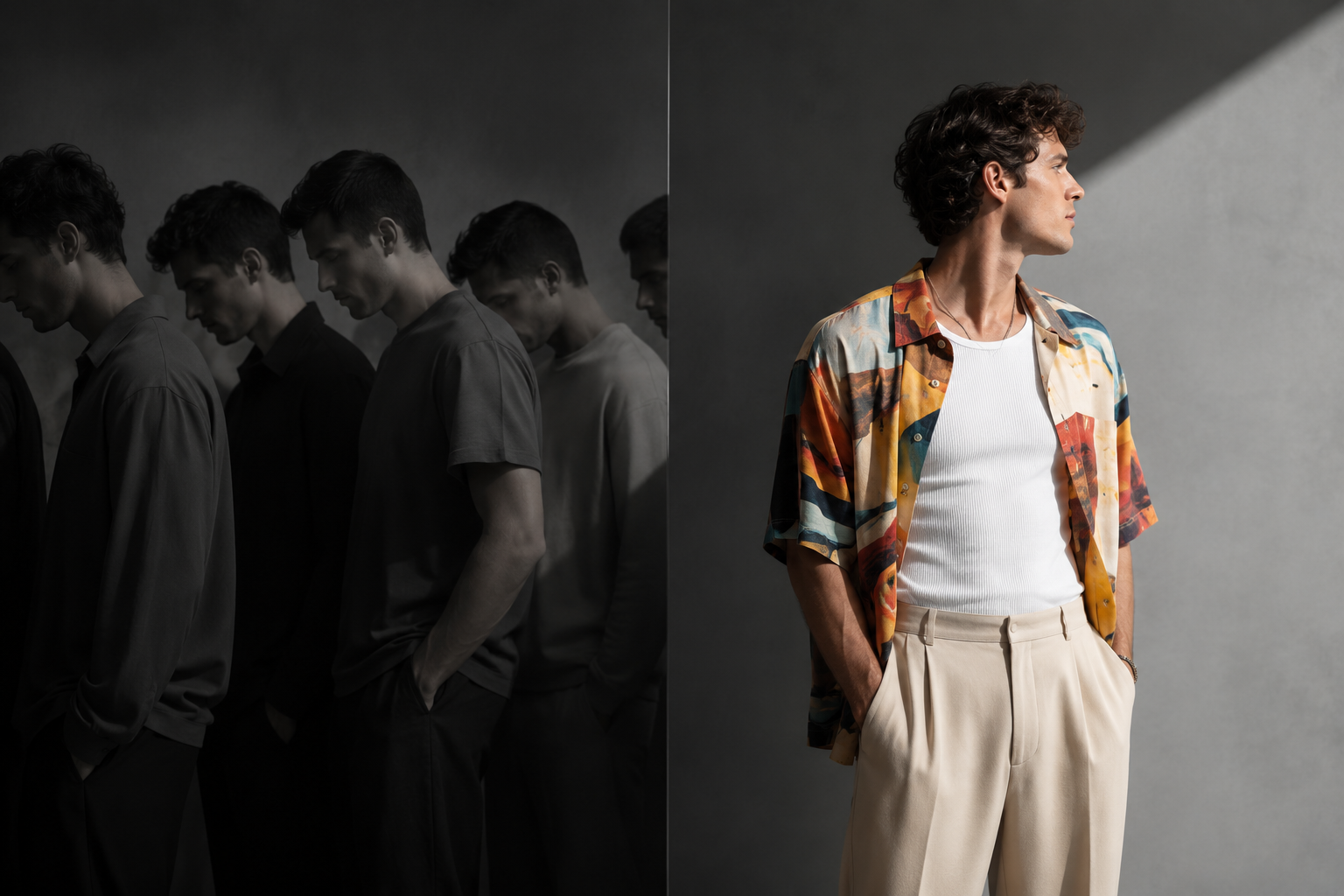
There’s a kind of man who likes fashion but has learned to hide that interest.
The one who, when picking a different t-shirt, already imagines the comments. Who thinks about wearing an accessory but leaves it in the drawer. Or buys a skincare product and treats it as a joke, as if taking care of yourself were something to be embarrassed about.
The big issue is that fashion is about belonging, identity, and life stage. After all, clothing is also a form of communication, regardless of gender.
And when we talk about men in fashion, there’s another layer that needs to be looked at: the pressure to look masculine “the right way.”
So let’s dig into this topic, because there’s a lot to talk about!
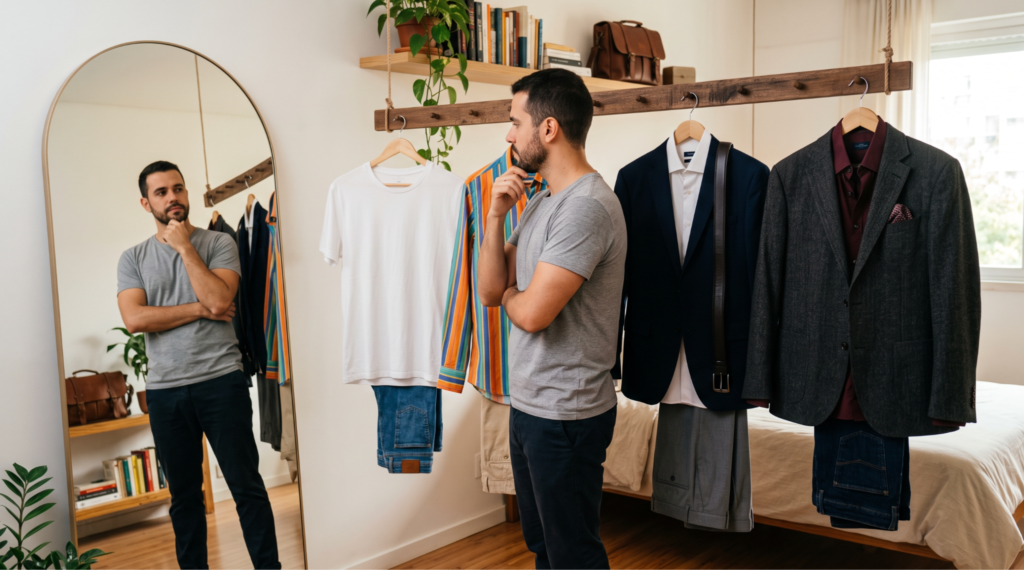
The “male fear” of looking exaggerated, feminine, or different
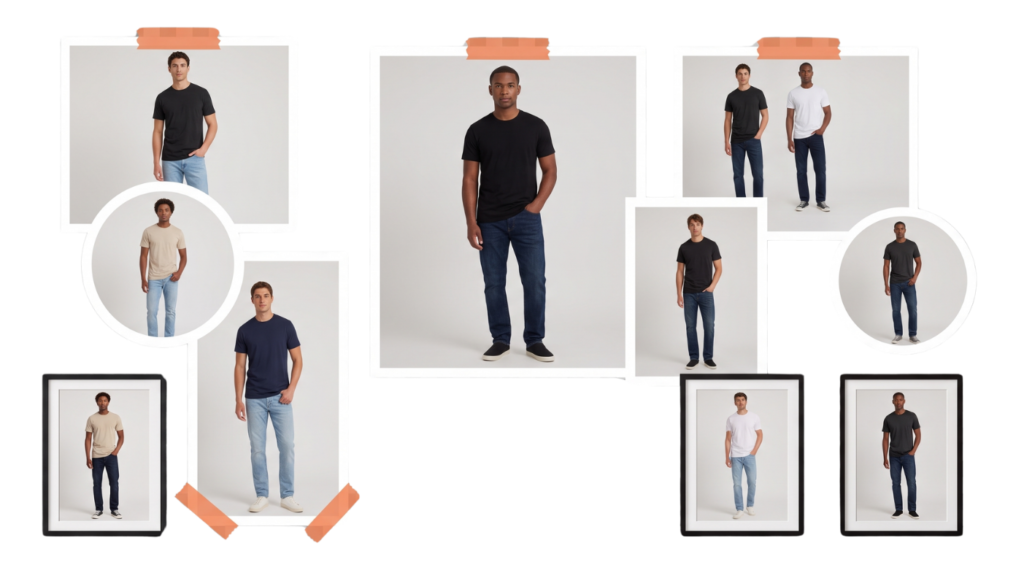
There’s a “safe uniform” in men’s style. Neutral t-shirt, basic pants, discreet sneakers. Even for those who dress more formally, the rulebook is the same: little color, little volume, and of course, no risk.
Nothing wrong with a basic style, I even have friends who wear it. The issue is adopting that style to erase yourself behind the clothes, claiming to have no interest in fashion, when in fact there’s a hidden bias at play.
Men avoid expressing themselves through style because they’ve learned that caring about their look can be read as weakness, oversensitivity, or vanity. The idea runs on the notion that caring about appearance is a feminine, emotional concern, while virility is tied to rationality and practicality in their crudest form.
How fragile masculinity limits style choices
Fragile masculinity is everywhere. In the comment about the pink shirt, in the joke about someone who takes care of their skin, in the odd looks when someone wears a different accessory; a bag, an earring, painted nails, or even more fitted clothing. The biggest fear seems to be ever stepping outside the norm and always having to prove you’re “man enough.”
As if fashion, beauty, and style were exclusively female territory. This has forced the male wardrobe to fit within too narrow a ruler. In practice, this also limits presence and personality: the man doesn’t wear what he likes, he wears what won’t be questioned.
Style and metrosexuality are not the same thing
You know when everyone in a room seems to be dressed in jeans and a black t-shirt? That’s a consequence of the silent agreement mentioned above: no one draws too much attention, no one seems too vain, no one risks hearing a joke.
There are many labels that make a man run from style like the devil runs from a cross. One of the best known is “metrosexual,” used to describe men who care more about their appearance than “normal,” as if that were some separate category.
But style and self-care don’t need to fall into the same bucket.
Having style is about understanding how you want to appear in the world (and basic style counts too, okay? As long as it’s a choice made for a purpose, like comfort).
Men’s style can be basic, classic, sporty, elegant, experimental and it can change according to life stage.
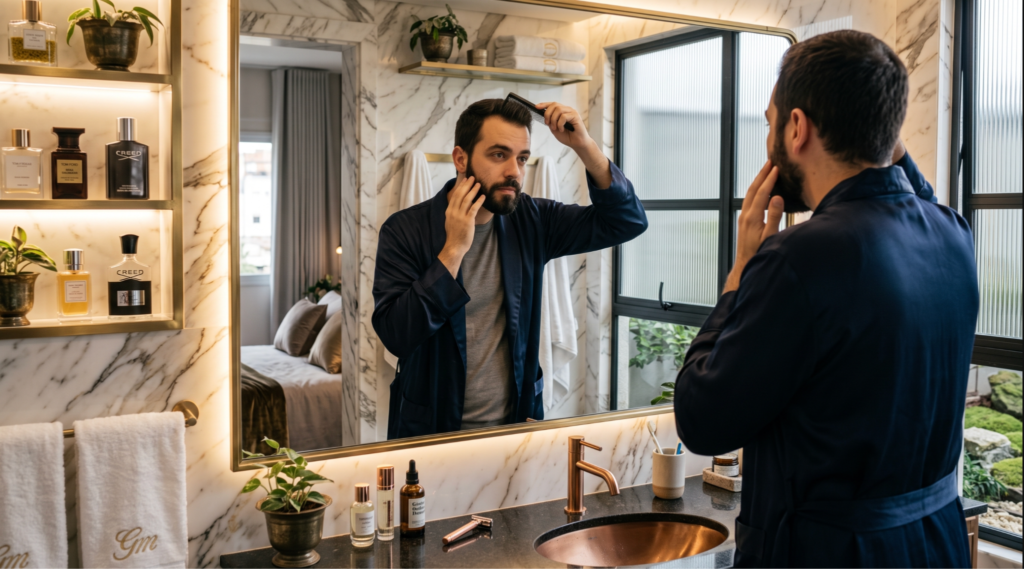
Self-care, on the other hand, is more related to caring for the body: skincare routines, beard care, nails, hair, hair removal, and so on.
Metrosexuality would be the “excess” in that care. I won’t get into the semantics of it here, but it’s worth pointing out that labels like this can turn something that should just be a habit (like taking care of your beard) into something seen as a threat to masculinity.
What’s changed with social media, Creators, and more diverse references
We know social media has the power to reinforce patterns and biases. But at the same time, this space has become a safe haven for men interested in fashion and style. For Creators, this topic opens up a powerful conversation.
Today, men find image consultants, barbers, image consultants (visagistas), stylists, skincare influencers, tailoring, streetwear, and men’s beauty accounts spread across every social network.
These creators play an essential role in expanding the range of what’s considered acceptable for men.
And the bigger screens have also opened up room for conversations about style, self-care, and men in fashion, with shows like Queer Eye, Dressing Funny, and the documentary Savile Row.
The Fashioning Masculinities exhibition at the V&A also reinforces that clothing builds our imaginaries of masculinity.
Men in fashion and freedom of expression
It’s more than time to shift the perspective — from seeing interest in style as “fragile masculinity” to seeing it as the ability to show range, insecurities, references, choices, and possible ways of existing.
A man can like a white t-shirt and jeans, wear colorful tailoring, take care of his skin, paint his nails, carry a bag, wear a skirt, style his beard, or grow his hair long. None of these decisions should need public defense.
At Flamus, Creators find a space to take this kind of conversation beyond the post, bring their audience closer, and build a more direct relationship with those who value what they create.