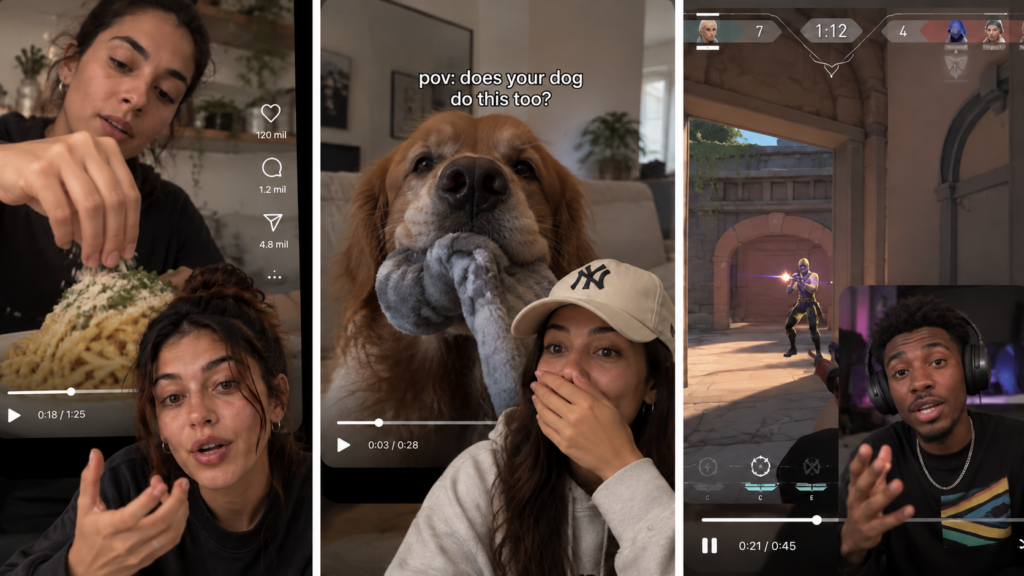
If you spend a lot of time online (on LinkedIn, Instagram, news websites, or even celebrity gossip pages) you may have noticed that a lot of content is starting to feel cookie-cutter.
Part of the reason is that so many people are now using the same recipe: AI. It’s great for organizing ideas, suggesting titles, outlining scripts, creating images, and helping any Creator overcome the blank page.
But when everyone uses the same tools in the same way, the results start to look the same too.
AI has an incredible ability to recognize patterns. And when it comes to content creation, that’s exactly where we need to be careful. For Creators, learning how to use artificial intelligence without erasing their point of view has become an essential ingredient.
That’s what we’ll break down here: where AI helps, where it gets in the way, and how to keep your voice at the center of your work.
Using AI Without Losing Your Voice Means Staying in Creative Control
Technology can speed up parts of the process, but the decisions about what to say, how to say it, and why it matters still need to be yours.
1. Use Artificial Intelligence as a Support Tool
AI can help organize the early stages of your creative process by:
- turning loose ideas into content topics;
- suggesting formats;
- outlining scripts;
- editing for clarity;
- identifying questions people are asking about a topic.
The problem starts when the tool stops supporting your decisions and starts making them for you. Your content may be produced faster, but it also starts to feel like it could have come from anyone.
2. Protect What Only You Can Say
Artificial intelligence can suggest a caption, a script, or a list of tips for Creators. But it doesn’t know what happens behind the scenes. It doesn’t know which questions keep coming up in your community, and it doesn’t understand your story, your sense of humor, your pauses, or the way you usually explain things.
This matters even more as audiences begin to place greater value on human-made content while synthetic content becomes increasingly common. According to an Ipsos report, 70% of people prefer online news articles created by humans, while 62% prefer advertising and social media marketing created by humans.
3. Start With Your Point of View
Before opening any tool, write one simple sentence that captures your opinion. This sentence will become the filter for your content.
For example: “AI helps Creators make better content when human intention remains in control.”
From there, you can ask for ideas, formats, and possible directions without allowing the tool to soften, water down, or change what you really want to say.
4. Ask for Options, Not Ready-Made Answers
Instead of asking AI to create an entire post, ask it to suggest possible angles, audience questions, practical examples, video formats, and ideas for exclusive content.
This way, technology becomes a thinking partner rather than a ghostwriter.
5. Trust Your Creative Process
Artificial intelligence can also support the visual side of creation. It can help you test references, develop video thumbnails, imagine scenes, and find clearer ways to present an idea.
The Ipsos report offers a useful insight here: AI tends to be more accepted when it improves aesthetics or makes a deliverable more efficient, but it faces greater resistance when it tries to manufacture trust.
AI-generated videos or images can work as experiments in visual language or as creative starting points, as long as the technology serves the idea instead of replacing it.
No matter the format, the principle remains the same: the tool must serve the message. Put your creative thinking first, and use AI to express your creativity more effectively.
When Using Artificial Intelligence Can Hurt the Creative Process
AI becomes a problem when it turns into a shortcut for publishing more content without thinking more deeply. At that point, it stops being a tool and starts operating on autopilot.
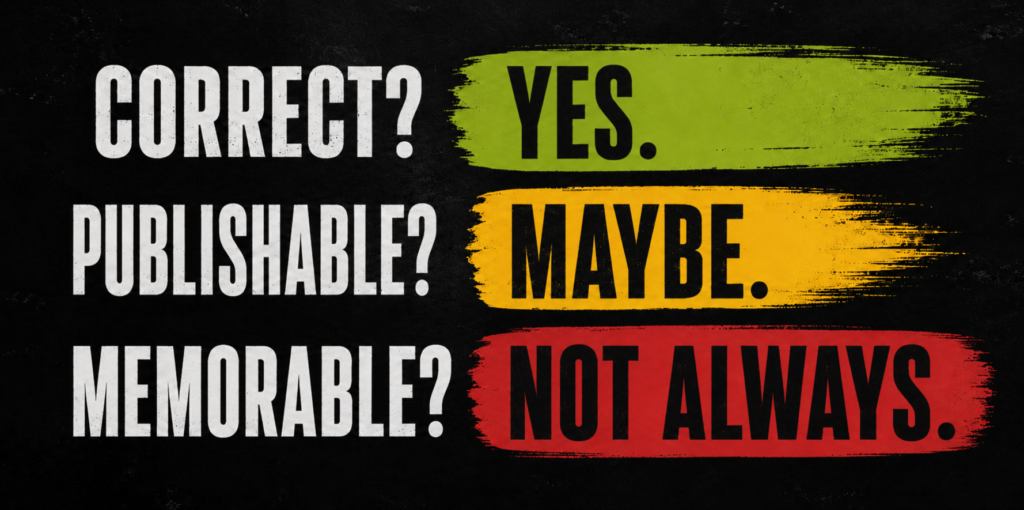
There is a type of content that explains, organizes, concludes, and then disappears. There’s nothing technically wrong with it. It just doesn’t leave a mark.
This risk is growing because AI is very good at producing plausible, polished, middle-of-the-road answers—the kind of content that seems useful at first glance but doesn’t create a genuine connection.
For Creators, this is the warning: communities don’t connect with information alone. They connect with the way you see and interpret that information.
That’s why, in a market where 79% of respondents want companies to disclose when they use AI, transparency and authorship can no longer be treated as afterthoughts.
Creating more doesn’t necessarily mean creating better. If AI increases your output but weakens your perspective, the benefit is fragile.
Instead of asking only, “How much content can I produce?” it’s worth asking, “What does this content add that isn’t already all over the internet?”
In the creator economy, innovation isn’t just about keeping up with trends. It’s about transforming your knowledge, experience, and conversations with your community into content with a recognizable signature.
How to Review Content Created With AI Support
The review stage is where your voice returns to the content. This is when you remove the excessive polish, restore your natural way of speaking, and make sure AI hasn’t made everything sound a little too perfect.
After generating a draft, run it through the voice test:
- Would I actually say this this way?
- Does this include a real point of view of mine?
- Is there a real example?
- Would my audience recognize this tone?
- Does this create connection, or does it only deliver information?
If any answer makes you uncomfortable, good. That discomfort shows you exactly where more human work is still needed.
Artificial intelligence can organize ideas, speed up processes, and open up new possibilities. It can save time, support visual creation, and help content creators overcome the blank page. But it cannot replace your personality, your perspective, or your responsibility for what you publish.
At Flamus, technology exists to support creation—not to take the Creator out of the spotlight.